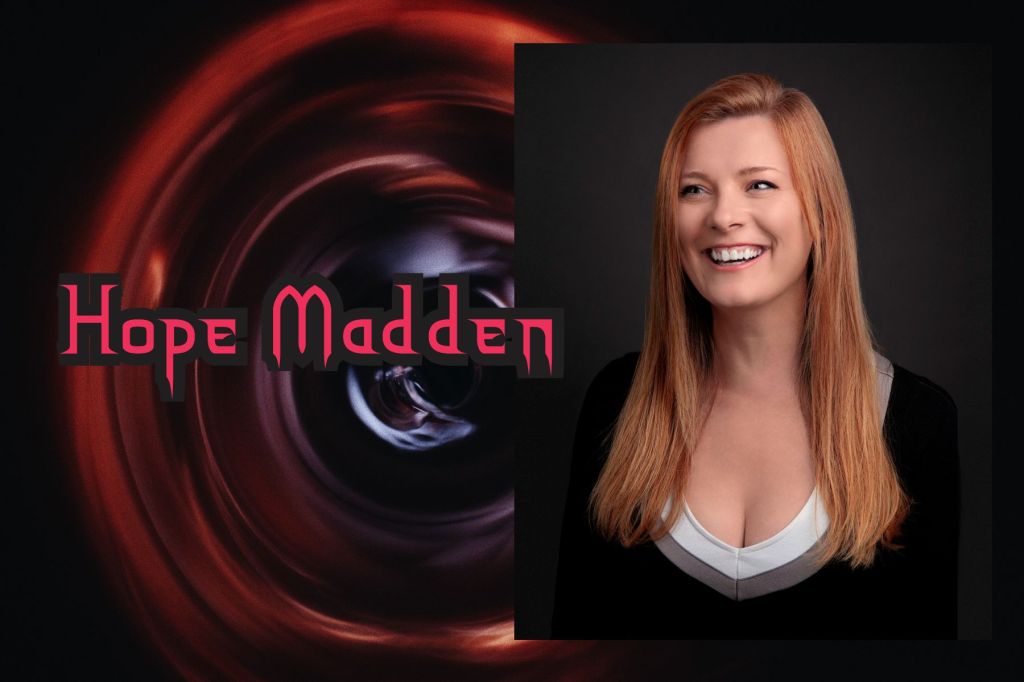
As part of our re-launch of Incubate: A horror collection of feminine power I am talking to a few contributors of the anthology this week, starting with filmmaker and author, Hope Madden.
I put out Incubate call for submissions after a long period of depression, following the overturn of Roe v Wade. We were still a very new press at the time and Incubate was only our second anthology as a publisher. I had a vision of what I wanted but I didn’t know if it was going to work. How do you put a primal scream of rage into a book?
But of the submissions that came back there were a few that let me know that I wasn’t alone in this rage, or in the desire to unleash the power behind it. Hope Madden’s “Aggrieved” grabs readers by the throat and lures them through a quiet college town, into a the squirming mind of an incel.
So, now I’m catching up with Hope who has been very busy doing very cool things.
First of all, why don’t you give us a little bit about your background and what you’ve been working on recently.
Thanks for asking! I’m a writer, film critic and filmmaker based in Columbus, Ohio. I have a short piece called “Meat” out now in Wicked Shadow Press’s anthology Flash of the Dead: Requiem. I’m also in post-production right now on a new short film, a horror story about kids in a basement called Basement Buddy.
What drew you to the Incubate Call for Submissions?
I loved the feminist rage in the call. Loved it! And I’d been working on a short about redirecting the vampire’s need for virgins so that it could do humanity some good, and it felt like an excellent fit.
What were your inspirations for your short story, “Aggrieved?”
I want to love vampire stories, but the idea that the virgin is necessarily a beautiful young woman–Oh, the tragedy! The wasted fuckability!–has driven me crazy since I was a kid. But talking about some angry white dude with a manifesto and a gun on a campus once with my niece led me to the obvious solution to the incel problem. And there are two small colleges in my hometown, so I kind of imagined a vampire stalking the streets looking for a disgruntled young man to eat.
Your big project the last few years has been your film, Obstacle Corpse. Can you tell us a little bit about that and where readers can watch it?
I can! It’s about a young woman who wants to prove to her survivalist father that she can take care of herself. She drags her best friend to an obstacle course race without knowing that one of the obstacles is to kill another runner.
It was inspired by those Tough Mudder type races, which I have been to. I was supposed to run one, but foot surgery kept me sidelined. I went anyway to take pictures of my husband, George (who produces and has a small role–but a great kill!). These races are always deep in the woods, and I just kept thinking how easy it would be to die on these obstacles. Or to kill someone. I essentially had the film outlined by the time we got home.
It’s funny and bloody–I think we kill 41 people. All practical effects (thanks to the incredible genre veteran David Henson Greathouse), fun music from a bunch of bands who let us use their songs, and just an amazing cast top to bottom. It’s streaming now on Prime, Tubi, Vudu, Plex and Hoopla.
What themes do you like to work with?
I think there’s often a kind of bent sense of social justice in what I write. I gravitate toward small town horror as well.
What are some of your favorite feminist horror stories both in film and in books?
Charlotte Perkins Gilman’s The Yellow Wallpaper, of course. And Toni Morrison’s The Bluest Eye and Beloved–again, of course. I love everything by Flanner O’Connor and Shirley Jackson, much of which leans feminist, I think. And Frankenstein, which may not read like feminism but was itself a breathing, bleeding act of feminism.
In film, it’s a long list: Knifes and Skin (2019) and Perpetrator (2023), both by Jennifer Reeder, Raw (2016, Julia Ducournau), A Girl Walks Home Alone at Night (2014, Ana Lily Amirpour), The Woman (2011, Lucky McKee), The Love Witch (2016, Anna Biller), Suspiria (2018, Luca Guadanino), The Silence of the Lambs (1999, Jonathan Demme), The Babadook (2014, Jennifer Kent), Jennifer’s Body (2009, Karyn Kusama), Ginger Snaps (2000, John Fawcett), and Watcher (2022, Chloe Okuno).
This is one of the things that drew me to horror movies in the first place. People have always said that horror was misogynistic–and for sure, there is no end to the films that sexualize violence against women. But it’s always, always been more accepting of women filmmakers than mainstream movies: Mary Harron, Clair Denis, Mary Harmon, Antonia Bird. Alice Guy-Blache directed a version of Faust in 1903. Women know fear better than men do. We’re made to create horror.
What do you think about the term “strong female character”?
I’m sorry it’s a necessary phrase. It’s another reason we need to make our own horror–not just because it’s the best way for us to see women as something other than the victim. It’s also a way to see women as human: flawed, unlikeable, angry, disinterested, whatever. It’s the only way to make sure we get all the good lines, too.
What are the differences between writing stories for film and story writing for books?
You can be more imaginative when you write for books (at least in my experience) because movies cost too much to make. You start with this great tale (because I can’t censor myself as I’m writing), and then I have to go back and limit locations, limit characters, cut any car crashes or monster that would require budget I will never have.
You don’t have to limit your imagination for any reason at all when you write for a book, and it’s incredibly freeing and rewarding. It’s also solitary. It surprised me how much I enjoy watching actors translate my characters. I didn’t think I would like it, but I love it. It’s a very cool collaboration. But there’s also something magical about just writing, just being alone with it.

What draws you to horror?
You can do more with horror than you can with anything else. You can represent anything, address anything. You can write a literal nightmare, something that feels like it has no real plot, and strike a chord because we all have the same nightmares. Or you can recreate the banal horror of the real world but replace the source of the pain with a vampire or a monster or a zombie plague, which lets everyone work through the horror and survive it. Horror is the most flexible and satisfying genre.
What are your hopes for the younger generations of women?
To just please take over. Please. Take over everything: government, industry, cinema, literature, medicine, everything.
Last of all:
I’m working on an illustrated novelization of Obstacle Corpse, which should be really fun. It’ll give a little background on why different teams came, who wanted to kill whom and why. I’m hoping to work with a different Columbus, Ohio-based artist for each chapter. The goal is to have it available around the same time as the Blu-ray.
Bio:
Hope Madden (she/her) is a writer, filmmaker and film critic based in Columbus, Ohio. Her novella, Roost, published in March of 2022 with Off Limits Press. Her short story “Aggrieved” is featured in the 2022 feminist horror anthology, Incubate, from Speculation Publications, and her short “Meat” is part of the Wicked Shadow Press 2024 anthology Flash of the Dead: Requiem. Her first feature film, Obstacle Corpse, is now streaming on Amazon Prime.
Find her at:
facebook @hope.madden.102
facebook: @obstaclecorpsefilm
Instagram: @obstaclecorpsefilm
Threads: @obstaclecorpse
 LC W. Allingham
Leave a comment